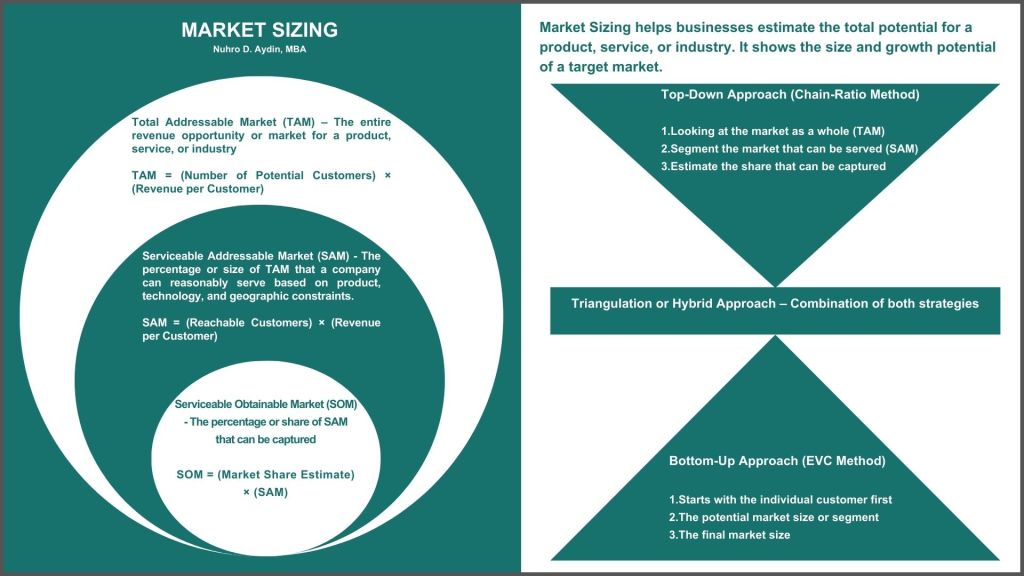
Market sizing is a critical process that assists businesses in estimating the total potential for a product, service, or industry. By understanding market size, companies can gauge both current and future growth opportunities within a specific target market. This analysis is typically broken down into three key components: Total Addressable Market (TAM), Serviceable Addressable Market (SAM), and Serviceable Obtainable Market (SOM).
Total Addressable Market (TAM):
TAM represents the complete revenue opportunity available for a particular product, service, or industry without considering any constraints. It provides a macro view of market potential, allowing businesses to understand how large the market is on a broad scale.
To determine TAM, one must first identify the total number of potential customers within the market and estimate the average revenue that can be derived from each customer.
Serviceable Addressable Market (SAM):
SAM is the portion of the TAM that a company can realistically serve, considering constraints such as product capabilities, technological limitations, and geographic factors. It narrows down the market focus to those customers that the business can reach and serve effectively.
This calculation helps businesses target their marketing and sales strategies more effectively by homing in on a more attainable customer base.
Serviceable Obtainable Market (SOM):
SOM is the segment of SAM that a company can feasibly capture within a specific timeframe, often referred to as the company’s market share estimate. It provides insight into the potential revenue the business can realistically expect to generate.
Understanding SOM is crucial for businesses to set achievable sales targets and refine their operational strategies.
To perform market sizing, companies often employ two primary methodologies: the Top-Down Approach and the Bottom-Up Approach.
Top-Down Approach (Chain-Ratio Method):
- Begin by analyzing the overall market to estimate the Total Addressable Market (TAM).
- Next, segment the TAM to define the Serviceable Addressable Market (SAM), focusing on the sectors that can be served based on the company’s unique capabilities.
- Finally, estimate the market share that can be realistically captured to determine the Serviceable Obtainable Market (SOM).
Bottom-Up Approach (EVC Method):
- This method starts by identifying individual customers and assessing their potential value.
- From there, the focus narrows to establish the potential size of the market segment that these customers represent.
- The final step is to aggregate the insights to arrive at the total market size.
Triangulation or Hybrid Approach:
This method combines elements of both the Top-Down and Bottom-Up approaches, leveraging the strengths of each to enhance the accuracy of market size estimates. By reconciling findings from both methodologies, businesses can achieve a comprehensive understanding of their market potential.
Using these frameworks, businesses can effectively navigate their market landscape and make informed decisions about growth strategies and resource allocation.

 The Baryawno Insights
Leave a comment